“Since I am unable to come to the room, the room must come to me”
On January 12th, 2023, from 04:00pm to 05:00pm CET, ENVITER had its first webinar of the year, this time about Active Learning.
Active Learning is an intervention for children and grown-ups who are – due to their impairments -, not able to explore their environment with their hands, feet, or body. They learn to be a passive rather than active participant, waiting for adults to provide activity rather than seeking it out on their own. We see this kind of behaviour mostly by young children with severe visual impairments, and by people with PIMD (profound intellectual and multiple disabilities) and visual impairments.
Active Learning emphasizes creating a developmentally appropriate and enriched environment so that children and adults with multiple special needs become active learners.
This webinar provided more information and examples about Active Learning and how this intervention challenges persons to make physical contact with materials and objects in their nearby space.
We can contribute!
The University of Amsterdam (the Netherlands) and Ghent (Belgium) are collaborating in the development of a tool to map the functioning of people with visual loss. They are conducting a worldwide research that can make a big difference in the near future for blind and visually impaired people around the globe.
And they need our help!
Their online survey is part of a broader research into the development of an International Classification of Functioning, Disability and Health (ICF) core set for people with vision loss. A core set tries to map the factors that influence the quality of life and describe what is relevant for functioning.
Blind and visually impaired people experience problems in different areas of daily life. In particular, they face a reduction in activities associated with participation in society, religion, mobility, recreation and visual tasks. How a person experiences vision loss varies depending on personal and environmental factors and will be interpreted differently for everyone. It will negatively affect the degree of independence, the ability to participate in daily life and the quality of life. In addition, this target group has an increased risk of social isolation, depression and falls.
That is why they would like to receive input from persons with vision loss as well as from professionals, so they have two different online questionnaires:
– Persons with vision loss can participate by clicking on this link: https://lnkd.in/g3vccvma
– And professionals by using this link: https://lnkd.in/gVKjbgQb
The entered data will be processed anonymously and can never be linked to you as person.
https://enviter.eu/wp-content/uploads/2022/11/icf1.jpg5231000Vera Rapagãohttps://enviter.eu/wp-content/uploads/2022/02/logo-enviter-color.svgVera Rapagão2022-11-30 13:54:422022-11-30 14:22:10Help Develop ICF Core Set for Vision Loss
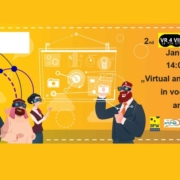
The ERASMUS+ project “Virtual Reality For Visually Impaired People” (VR4VIP) evaluates products, research results and experiences of VR in the education of visually impaired people. The second online conference, also an ENVITER webinar, will be held on January 26th, 2023 from 14:00 to 16:55.
https://enviter.eu/wp-content/uploads/2022/11/2nd-vr4vip2-scaled.jpg13392560Juergen Heullenhttps://enviter.eu/wp-content/uploads/2022/02/logo-enviter-color.svgJuergen Heullen2022-11-29 05:10:552023-01-12 07:30:49Virtual Reality in Vocational Training
Resulting from a close collaboration in The Netherlands between Saxion University of Applied Sciences, Royal Dutch Visio, Bartiméus, Oogvereniging, NHL Stenden University of Applied Sciences, Studio Z and expert users, a video was developed as a mean to support good practices to develop Inclusive Online Meetings. In this video, special attention is paid to the question of how you can have a good and effective online meeting if one of the participants has a visual impairment. The video provides concrete suggestions and tips. It can also be used as a guideline: ‘meeting rules’ in an hybrid form of education.
This ressource is a research outcome of a project on the impact of the COVID-19 regulations on the wellbeing of persons with a visual impairment and deafblindness and was presented in ENVITER’s last General Meeting, in Angers, by Mijke Hartendorp, one of the researchers involved.
If you are interested in further collaboration or exchange about this topic, please feel free to contact us through our contact form, refering the subject “Inclusive Online Meetings” in your message.
This year, the theme was 3D, on October 25 and 26.
Over the two days, the Berufsförderungswerk Düren was the location of an advanced training course for nine colleagues from seven European countries. These colleagues are trainers from seven European educational institutions for people with visual impairments. The topic of the training was the production of tactile teaching materials for blind students using 3D printing . The highly condensed course, focused on the operation of 3D printers, as well as the basics of design using CAD software.
All participants were surprised that the operation of a 3D printer is relatively simple. The motivation of the participants to use this technology in their companies was correspondingly high.
The 3D printing technology is regularly covered in the media. The possible applications of this technology seem limitless and are increasingly finding their way into the private sphere, e.g. for upcycling of everyday objects or the production of spare parts that are no longer available. 3D printers are becoming more and more powerful and user-friendly and are now affordable for everyone. In fact, 3D printing offers many advantages for many creative home- and model makers. In the field of education for people with visual impairments, tactile teaching materials can be produced easily and affordably.
However, there is still a prevailing opinion that 3D printing can only be done by IT specialists and technicians.
This introductory course aimed to provide answers to these very questions. Contents of the course were:
Private application areas of 3D printing
Different 3D printing processes and materials
Costs and effort
Advantages of 3D printing compared to conventional manufacturing methods
Obtaining parts from databases, 3D scanning and design
Demonstration of various printing processes
Practical operation of a 3D printer
Basic construction with Autodesk Fusion360
This trainng event was held by our member BFW Düren (Germany) with the support of ENVITER. To have a 360° view on the training area, where the course is taking place: Click here
Once a year, we wish our member’s professionals to meet so they can have a training experience usually focusing on content about new and innovative methodologies, practices and tools that often resulte from our projects. It is a perfect time to exchange ideas, train our professionals, create some links between them and develop smaller internal networks of specific professionals working in the same areas.
https://enviter.eu/wp-content/uploads/2022/10/2022-Training-Event.jpg5231000Vera Rapagãohttps://enviter.eu/wp-content/uploads/2022/02/logo-enviter-color.svgVera Rapagão2022-10-28 14:01:552022-11-02 11:34:042022 Training Event – 3D
These annual BSM are developed with the financial support of the network itself, sponsoring the involvement of a person per member and this way promoting the opportunity to meet together and to take part in the growth of ENVITER, by encouraging work on new project topics and proposals for submission for funding.
Held on July 14th 2022, the “Virtual- and Augmented Reality for Visually Impaired People” Online Conference was the first of three public events to share experiences about Virtual Reality (VR) and Augmented Reality (AR) products, researches and projects concerning visually impairment. This event was hosted by our BFW Düren (Germany) member, within the scope of the VR4VIP Project. Five other ENVITER members are part of this project.
During this Conference, 6 experts from 4 different countries presented products and research results, as well as their experiences with VR, for an audience of about 40 participants from 10 different European countries (Austria, Belgium, Bulgaria, Denmark, Germany, Italy, Portugal, Rep. Ireland, Spain and The Netherlands).
Math is one is the most challenging subject for many students. Graphical information and the level of abstraction in mathematics makes it inaccessible and specially difficult to comprehend for blind students. However mathematics is therefore a very important part of education, because the knowledge and skills that are acquired are applied in all kinds profession and daily situations.
To make math more accessible, useful and possibly even more fun, Visio has developed the iPhone app SenseMath. With SenseMath, every mathematical function (like y is x squared plus 3) can be converted into sound. With an audio representation of a graph it’s possible to get a quick overview of a graph. It’s give information about the sort function it concerns, like a mountain or valley parabola and the number of function that are presented in the graph. The mathematical elements, such as intersections and extrema, are made audible as well and the playback speed can be easily changed. SenseMath is not a calculator; reading the coordinates of a point is unfortunately not possible. But still it’s a very valuable addition to tactile drawings.
SenseMath has been developed with a large group of experts of mathematicians, programmers, accessibility experts and end users to achieve the best usability and accessibility.
In the app a function can be entered using the math keyboard specially developed for SenseMath. Each function is displayed in image, speech and braille, via a linear or mathematical notation. In addition to the functions, mathematical elements, such as intersections and extrema, can be toggled on or off in sound during playback with the use of the VoiceOver rotor. The user is in control and determines the most desirable way to analyse a graph. SenseMath makes optimal use of VoiceOver functionalities.
For a Dutch student it’s possible to upload every graph from a specific math text book, by entering the ISBN number of the book.
In April 2022 SenseMath won two Dutch Interactive Awards; the most important awards in the Netherlands for online content. The jury of ‘tools’ category” saw a cross-media approach at its best, built around user-centric design. This is clearly an innovative new interface with a huge and positive impact for the target group: an admirably well and extremely well executed concept”. In the category ‘future interfaces’ the jury “particularly appreciated that this is indeed a completely new interface: exactly what this category is all about. The impact of this product is enormous and the worldwide potential is great.”
To make this come true Visio is always open for suggestions and tips to improve SenseMath. If it would be possible to make it more accessible and fit for students outside of The Netherlands, Visio would love to be in contact to talk about your thoughts and concerns. So please contact Visio through visiolab@visio.org.
https://enviter.eu/wp-content/uploads/2022/07/sensemath.png13592598Vera Rapagãohttps://enviter.eu/wp-content/uploads/2022/02/logo-enviter-color.svgVera Rapagão2022-07-08 08:08:052022-07-15 08:39:33SenseMath – Making Sense of Math
Six ENVITER partners cooperate in the ERASMUS+ project “Virtual Reality For Visually Impaired People” (VR4VIP). The aim of this project is to evaluate products, research results and experiences of VR in the education of visually impaired people. The first online conference, also an ENVITER webinar, will be held on July 14th, 2022 with an exciting programme. Interested members should register here->
https://enviter.eu/wp-content/uploads/2022/05/conference-vr4vip.jpg5231000Juergen Heullenhttps://enviter.eu/wp-content/uploads/2022/02/logo-enviter-color.svgJuergen Heullen2022-06-29 12:00:282022-06-29 13:14:22Virtual Reality for Visually Impaired People – Online Conference and Webinar
We had a wonderful meeting! After 2,5 years and the serious pandemic times, we had our first General Meeting in person in Angers on 12 to 14 April.
From 14 different European countries, 17 member organisations could attend the meeting with 32 participants. The meeting was organised by the Institute Montéclair of VYV 3 Pays De la Loire.
Beyond our general meeting, this occasion was very special, because our network celebrated its 20th anniversary. Thanks to our former president Mr. Francis Guiteau, who is the current deputy mayor in Angers, the members were invited for an official ceremony to the Hotel de Ville d’Angers.
We also had our annual Conference Day. The purpose of our Annual Conference is to create an intellectual platform for professionals to share their theoretical and practical knowledge in the field of vision impairment, focusing especially on innovative methodologies, practices and tools.
This year the main topic was “Positive side effects of covid on inclusion of VI people” – Good Practices, Opportunities, Future Plans, Takeaways”
The last day was dedicated to projects and future collaborations. We talked about the new ways of funding, the EU accreditation process and about project proposals and also prepared the upcoming Blue Sky Meeting and the next Summer Course.
All the participants emphasized the importance of personal meetings. Beyond the professional work we had time for informal talks as well, and could really feel the dynamism and strength of our network.
Happy birthday ENVITER!
https://enviter.eu/wp-content/uploads/2022/04/group-photo-angers-poor-size-ok1.jpg5231000Vera Rapagãohttps://enviter.eu/wp-content/uploads/2022/02/logo-enviter-color.svgVera Rapagão2022-04-18 12:50:302022-04-21 14:11:452022 General Meeting – Angers, France
We use cookies to ensure that we give you the best experience on our website. If you continue to use this site we will assume that you are happy with it.








 Adobe Stock Licebsed by BFW Düren


